
Table of Contents
- Why Understanding Common Trading Mistakes Matters
- 1. Trading Without a Stop Loss
- 2. Taking Positions That Are Too Large
- 3. Revenge Trading After a Loss
- 4. Ignoring a Trading Journal
- 5. Not Understanding Which Setups Actually Work
- 6. Trading at the Wrong Time of Day
- 7. Moving Stop Losses Further Away
- 8. Overtrading
- 9. Chasing Trades Out of Fear of Missing Out
- 10. Never Reviewing Past Trades
- How These Top 10 Trading Mistakes Work Together
- What Successful Traders Do Differently
Every successful trader has one thing in common: they have made mistakes.
Some mistakes cost a few dollars. Others cost entire trading accounts. The unfortunate reality is that most beginners don't fail because they lack intelligence or motivation. They fail because they repeat the same errors over and over until their confidence, capital, and discipline disappear.
Whether you're trading forex, stocks, crypto, or commodities, the market has a way of exposing weaknesses very quickly.
The good news is that most of these mistakes are avoidable.
At TraderTruths, we regularly hear stories from traders who wish they had learned certain lessons earlier. Many of their experiences reveal the same patterns—mistakes that seem small at first but become extremely expensive over time.
In this article, we'll explore the top 10 trading mistakes that cost beginners money and discuss practical ways to avoid them.
Why Understanding Common Trading Mistakes Matters
Most traders spend countless hours searching for profitable strategies.
They study indicators, chart patterns, and market analysis techniques.
Yet many ignore the real reason traders lose money: poor habits and emotional decision-making.
Understanding common trading mistakes helps traders:
- Protect their capital
- Improve discipline
- Manage emotions better
- Avoid unnecessary losses
- Develop long-term consistency
Success in trading is often less about finding the perfect strategy and more about avoiding costly mistakes.
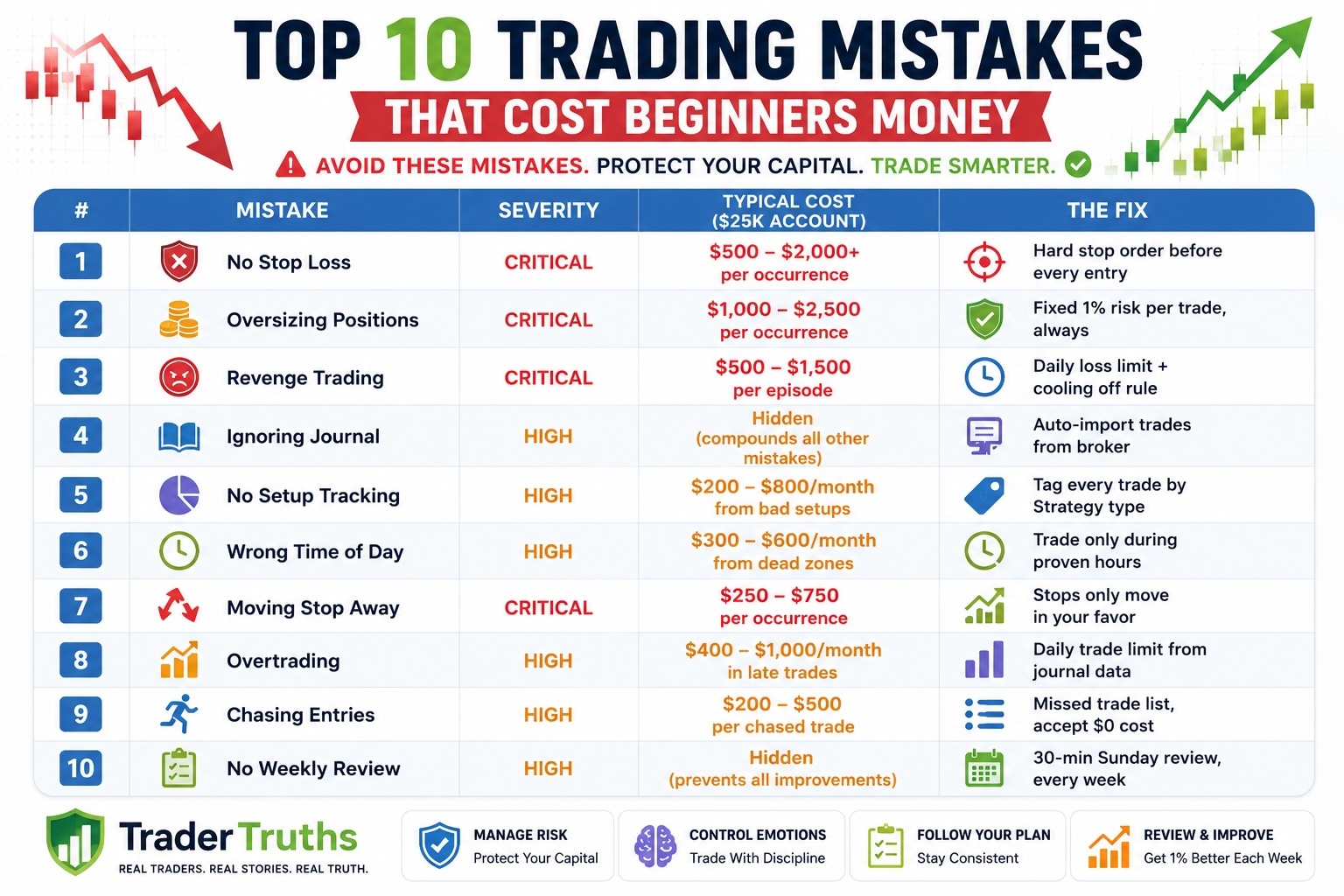
1. Trading Without a Stop Loss
One of the fastest ways to destroy a trading account is entering trades without a stop loss.
Many beginners believe they can simply watch the market and exit manually if things go wrong. Unfortunately, markets can move faster than expected.
A small loss can quickly become a major problem when there is no defined exit plan.
Why It Happens
- Fear of being stopped out
- Overconfidence
- Hope that the market will reverse
The Solution
Always define your risk before entering a trade.
Use stop-loss orders and decide in advance how much you are willing to lose if the trade fails.
A small planned loss is far easier to recover from than a large unexpected one.
2. Taking Positions That Are Too Large
Another common trading mistake is risking too much on a single trade.
Many beginners find a setup they strongly believe in and decide to increase their position size dramatically.
The problem is simple:
No setup is guaranteed.
Even the best traders experience losses.
Why It Happens
- Overconfidence
- Desire for faster profits
- Emotional attachment to a trade
The Solution
Risk only a small percentage of your account on each trade.
Many experienced traders risk between 1% and 2% of their capital per trade.
Consistent position sizing helps protect your account during losing streaks.
3. Revenge Trading After a Loss
Few mistakes damage trading accounts faster than revenge trading.
Imagine losing money on a trade and immediately opening another position simply to recover the loss.
This usually leads to even larger losses.
Why It Happens
Losses trigger emotional reactions.
Many traders feel frustrated and try to win back money quickly.
The Solution
Create a daily loss limit.
If you reach that limit, stop trading for the day.
Walking away is often the smartest trading decision you can make.
4. Ignoring a Trading Journal
Many traders keep records for a few days and then stop.
Unfortunately, this makes improvement difficult.
Without a trading journal, it becomes almost impossible to identify patterns in your performance.
Why It Happens
- Journaling feels time-consuming
- Traders underestimate its value
The Solution
Track:
- Entries
- Exits
- Trade reasons
- Emotions
- Results
Over time, your journal becomes one of the most valuable learning tools you have.
5. Not Understanding Which Setups Actually Work
Many traders focus only on overall profits and losses.
However, successful traders analyze performance by setup type.
For example:
- Breakout trades
- Pullback trades
- Trend-following trades
- Reversal trades
Not every setup will perform equally well.
The Solution
Track each strategy separately.
You may discover that one setup consistently makes money while another repeatedly causes losses.
This insight can dramatically improve performance.
6. Trading at the Wrong Time of Day
Not all trading hours are equal.
Many traders perform well during certain market sessions and poorly during others.
For example:
- Some traders perform best during market opens.
- Others perform better during quieter periods.
Why It Happens
Market conditions change throughout the day.
Volatility, volume, and liquidity vary significantly.
The Solution
Review your trades and identify when your best results occur.
Focus on trading during your strongest hours.
7. Moving Stop Losses Further Away
This is one of the most dangerous common trading mistakes.
A trader enters a position with a stop loss.
The trade moves against them.
Instead of accepting the loss, they move the stop further away.
Now the risk is larger than originally planned.
Why It Happens
- Fear of being wrong
- Emotional attachment to a trade
The Solution
Once a stop loss is set, respect it.
Stops should only move to reduce risk, never increase it.
Discipline protects capital.
8. Overtrading
Many beginners believe more trades mean more opportunities.
In reality, more trades often mean more mistakes.
Overtrading typically occurs when traders:
- Get bored
- Feel emotional
- Force trades that aren't there
Signs of Overtrading
- Trading without a clear setup
- Entering multiple positions impulsively
- Ignoring your trading plan
The Solution
Set a maximum number of trades per day.
Focus on quality over quantity.
Often, the best trades are the ones you patiently wait for.
9. Chasing Trades Out of Fear of Missing Out
FOMO, or fear of missing out, is extremely common.
A trader watches a stock or cryptocurrency move rapidly higher.
Instead of waiting for a proper entry, they jump in late.
Moments later, the market reverses.
Why It Happens
People hate feeling left behind.
The Solution
Accept that opportunities never stop appearing.
Missing one trade is far better than entering a poor trade.
Successful traders understand that patience creates better opportunities.
10. Never Reviewing Past Trades
Many traders finish a trade and immediately move on to the next one.
They never analyze:
- What worked
- What failed
- What could improve
Without review, mistakes repeat themselves.
The Solution
Schedule a weekly review session.
Spend 30 minutes analyzing:
- Winning trades
- Losing trades
- Emotional decisions
- Rule violations
Small improvements compound over time.
How These Top 10 Trading Mistakes Work Together
One mistake often leads to another.
Consider this scenario:
A trader enters without a stop loss.
The loss becomes larger than expected.
Frustration sets in.
They revenge trade.
The next trade is oversized.
Several more emotional trades follow.
What started as a small loss becomes a major drawdown.
This chain reaction is surprisingly common.
That is why successful traders focus on building systems and rules that prevent mistakes before they happen.
What Successful Traders Do Differently
The most successful traders are not necessarily smarter than everyone else.
They simply avoid the mistakes that destroy most beginners.
Their habits often include:
- Using stop losses consistently
- Managing risk carefully
- Keeping detailed journals
- Reviewing trades regularly
- Following structured plans
- Controlling emotions
- Staying patient
Over time, these habits create consistency.
Learn From Other Traders' Experiences
One of the fastest ways to improve as a trader is by learning from people who have already made the mistakes you're trying to avoid.
At TraderTruths, traders from around the world share real experiences involving:
- Trading failures
- Emotional mistakes
- Recovery journeys
- Risk management lessons
- Success stories
These experiences provide practical insights that can save others both time and money.
Conclusion
The truth is that most beginners don't fail because they lack opportunity.
They fail because they repeatedly make avoidable mistakes.
The top 10 trading mistakes discussed in this article—such as trading without stop losses, overtrading, revenge trading, and ignoring trade reviews—are responsible for countless blown accounts.
The good news is that every one of these mistakes has a solution.
Trading success is not about perfection.
It is about making fewer mistakes, learning from experience, and continuously improving.
At TraderTruths, we believe that real trading experiences are some of the most valuable educational resources available. Every mistake contains a lesson, and every lesson can help another trader grow.
If you've learned an important lesson through your own trading journey, consider sharing your story. Your experience could help another trader avoid costly mistakes and make smarter decisions in the future.
FAQs
What are the most common trading mistakes beginners make?
Some of the most common trading mistakes include trading without a stop loss, overtrading, revenge trading, using oversized positions, and failing to review trades.
Why do most beginner traders lose money?
Most beginners lose money because of poor risk management, emotional decision-making, lack of discipline, and repeated trading mistakes.
How can traders avoid common trading mistakes?
Traders can reduce mistakes by following a trading plan, using stop losses, managing risk properly, keeping a trading journal, and reviewing their performance regularly.
What is the biggest trading mistake?
Trading without a stop loss is often considered the biggest mistake because it exposes traders to unlimited risk.
How important is a trading journal?
A trading journal helps traders identify patterns, track performance, and improve decision-making over time.
Can traders become profitable by fixing a few mistakes?
Yes. Many traders see significant improvements simply by correcting a handful of recurring mistakes and following a structured approach.
Follow us on our social media pages : Facebook, Instagram, X, Linkedin & Youtube.